One-line takeaway
Automate eligibility and recordkeeping; keep consent, service recovery, and sensitive customer context in control of explicit rules and people.
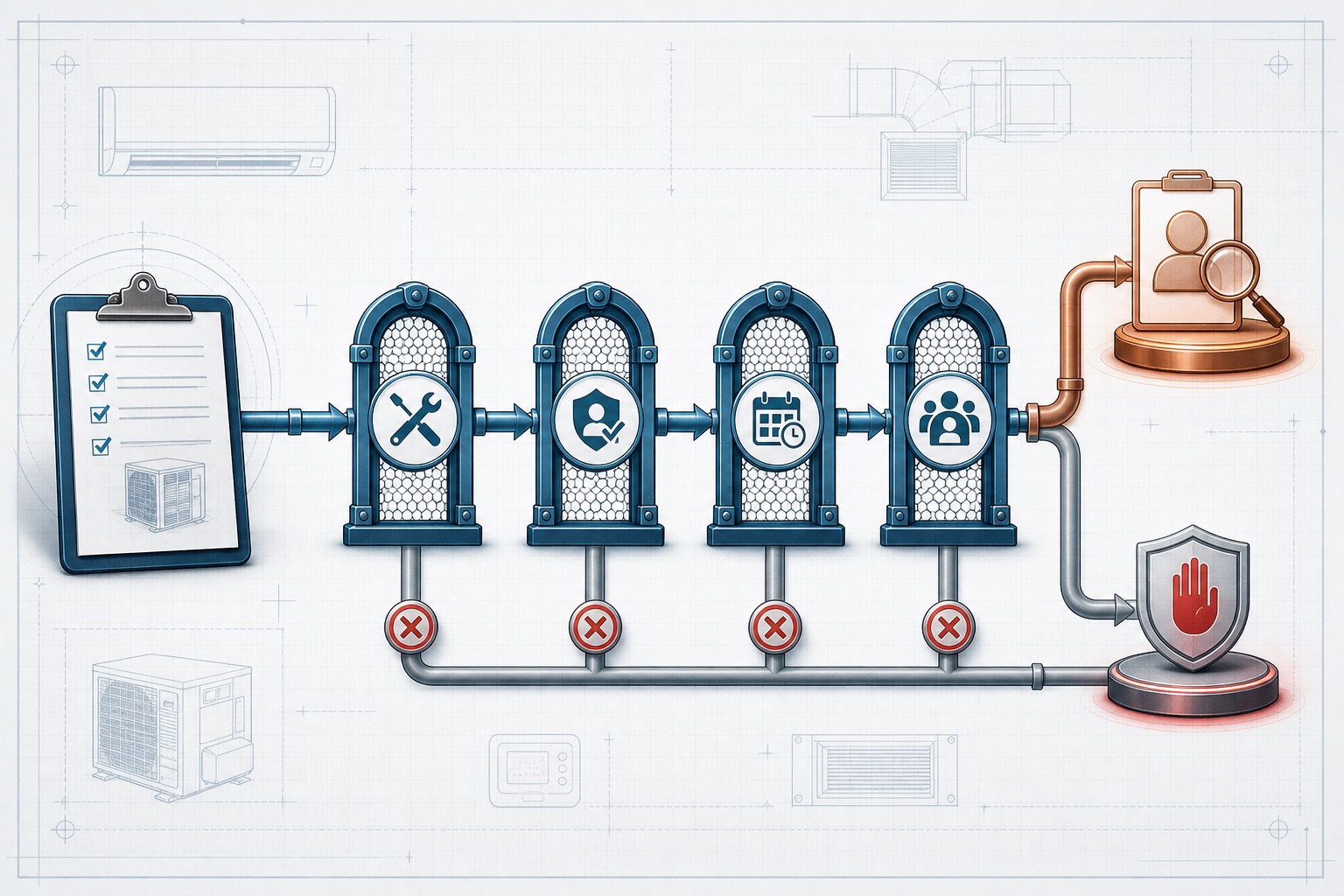
The source-backed signal
Commercial email and automated calls or texts are governed by channel-specific rules. The FTC’s business guidance describes CAN-SPAM requirements for commercial email, while the FCC publishes rules and consumer guidance for calls and texts. These sources do not tell an HVAC operator which customer should receive a membership offer; they establish why channel, consent, identification, and opt-out handling belong in the workflow design.
Interpretation
Independent operating interpretation: the post-job moment may be useful because the service context is recent, but recency is not permission. Eligibility must be narrower than “job complete.”
A completed job is a trigger candidate. It is not, by itself, consent, positive sentiment, or membership eligibility.
The operator checklist
1. Define an authoritative trigger
Use an audited completed or resolved service state. Exclude estimates, cancellations, duplicate jobs, callbacks still in progress, and records with an unresolved service issue.
2. Order suppressions before selection
- Existing or recently canceled member
- Open complaint, refund, or service recovery
- Invalid or missing channel consent
- Recent membership decline or contact-frequency limit
- Do-not-contact or legal suppression
3. Preserve human authority
A first version should capture interest and create an owned human follow-up. Keep enrollment, payment, discounts, exceptions, and retroactive concessions outside autonomous handling.
4. Keep the message contextual
Reference the completed service accurately, explain why the plan may be relevant, name the sender, and provide a clear way to decline. Do not imply a benefit or savings that the agreement does not support.
5. Log every state
Record the trigger, eligibility decision, suppression reason, consent basis, message version, send result, response, handoff, and final outcome. Retries must use the same idempotency key.
Measure the workflow, not just enrollments
| Metric | Denominator |
|---|---|
| Eligibility coverage | Completed jobs evaluated |
| Suppression rate | Jobs evaluated |
| Contact rate | Eligible contacts attempted |
| Positive response rate | Delivered contacts |
| Human follow-up completion | Positive responses assigned |
| Enrollment rate | Qualified conversations—not all jobs |
Next metric to watch: unresolved positive responses older than one business day. Automation creates relationship debt when interest is captured faster than a person can respond.
Sources and provenance
- Federal Trade Commission, CAN-SPAM Act: A Compliance Guide for Business.
- Federal Communications Commission, Rules for calls and texts.
- Workflow recommendations are independent interpretation, not legal advice. Confirm current requirements and your consent records with qualified counsel.
Conversion insight
Get the next practical workflow.
Related insights
Map the surrounding system.
Operations
The HVAC Membership Revenue Loop
Measurement
Five numbers before more ad spend
Reader question